
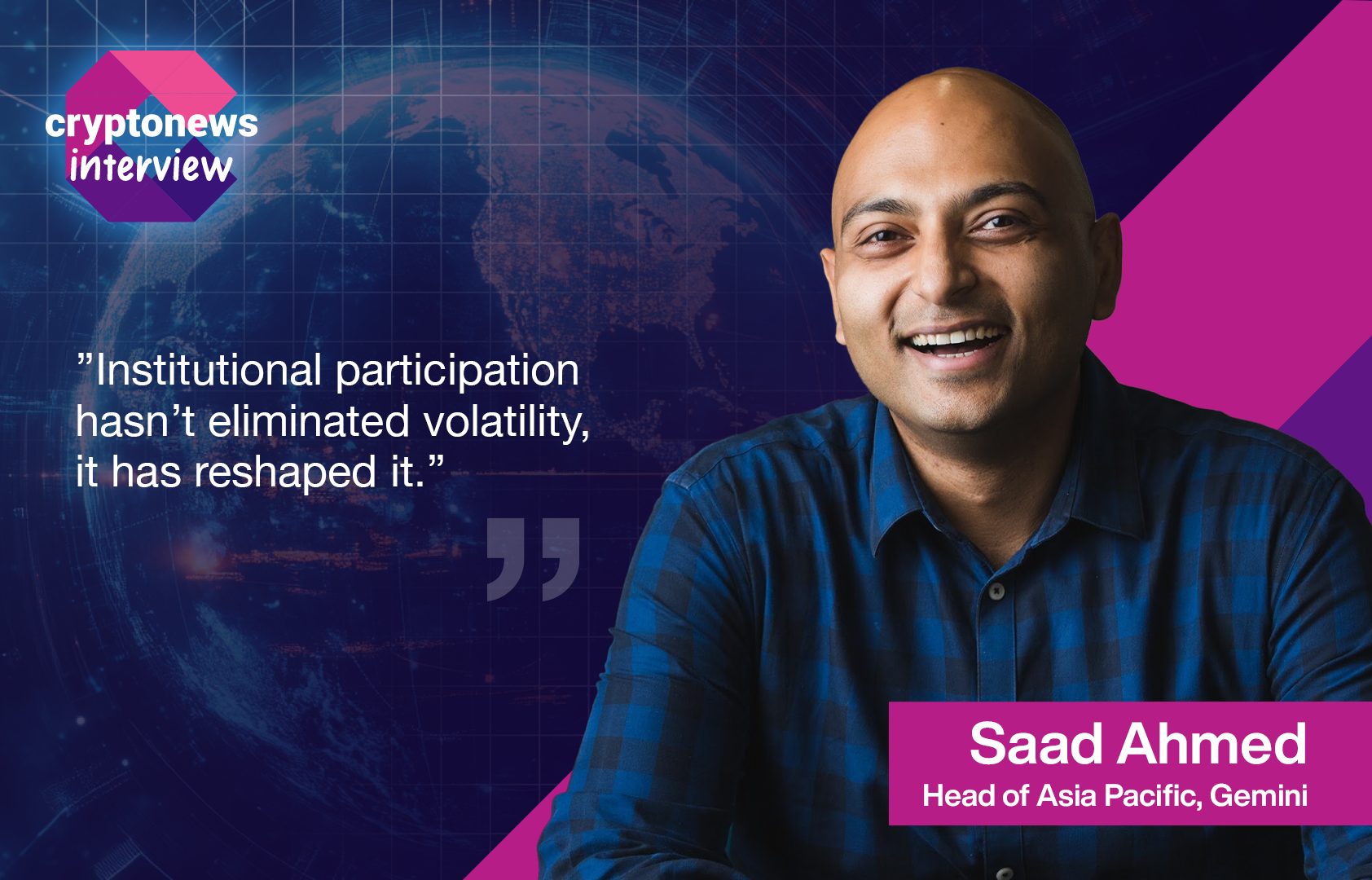
Crypto prices still jolt on every big macro headline, but a senior Gemini executive says the post 2022 market now snaps back differently, as institutions take the wheel on liquidity and longer-term positioning.
Saad Ahmed, Gemini’s head of Asia Pacific, said the presence of big investors has not smoothed out price action.
Instead, the market now absorbs shocks differently, with more activity tied to structured products, balance sheet decisions, and strategic allocation.
“Institutional participation hasn’t eliminated volatility, it has reshaped it,” Ahmed told Cryptonews in a recent interview. He added that the main miss in today’s debate is that volatility is now unfolding in a market he views as sturdier than earlier cycles.
Why Institutional Discipline Is Muting Crypto Market Shocks
As institutions increasingly use digital assets for collateral and portfolio construction, Ahmed said the focus has shifted away from day-to-day price flickers. “Short-term price movements are becoming background noise, while the focus remains on long-term positioning and fundamentals,” he said.
That mindset, he argued, helps explain why sharp sell-offs do not always spiral the way they once did. Where prior cycles often saw deep drawdowns turn into prolonged turbulence, he said the latest rebound showed more discipline in risk management as institutional players adjust exposure.
Between Nov. 19 to Dec. 19, 2025, crypto markets came under heavy selling pressure, with Bitcoin suffering its steepest monthly decline since mid-2021, sliding roughly 17% to 21% in November and retreating from near $100,000 to about $87,000 by mid-December as it tested support around $85,000 to $86,000.
Ethereum followed a similar path, falling from around $3,900 at the start of November to a low near $2,745 on November 21, before clawing back to trade around $2,900 to $3,000 by December 19, leaving the token down roughly 20% to 25% over the period.
Deliberate Capital, Not Fast Money, Drives Today’s Market
In Ahmed’s view, the gap between long-term positioning and short-term price action has widened, but it does not mean capital has left the space.
“Institutional capital is still flowing. It’s just flowing at a more deliberate pace,” Ahmed said, as firms treat digital assets less like a punt and more like a strategic component.
Traders, meanwhile, have fixated on ETF flows as a real-time scoreboard for demand. Ahmed said investors should treat that data as a useful read on mood, not a definitive signal on direction. “ETF flows are helpful indicators of short-term sentiment, but are not the sole compass for where the market is headed,” he said.
He pointed instead to the plumbing behind the trade, regulated rails, secure custody, and liquidity depth, as the foundations that keep institutions engaged even when prices whip around.
Beyond Price Charts, On-Chain Signals Shape Crypto’s Next Phase
Looking into 2026, the exec said the industry needs to judge health by more than price charts. He is watching on-chain fundamentals, including real-world asset activity and stablecoin usage, as indicators that can signal whether utility is expanding and confidence is building.
Across Asia Pacific, Ahmed said the most important shift has come from institutional adoption, not retail speculation. He pointed to 2025 momentum in ETFs, stablecoins, and treasury applications, especially in Singapore, Australia, and Hong Kong, as the region moves from cautious exploration to mainstream relevance.
That diversity also shapes Gemini’s playbook, he said, because regulatory approaches differ sharply across markets.
Gemini’s recent expansion into Australia fits that strategy, with the company building local teams to serve both institutions and retail clients, while it scouts additional markets over the longer-term.
The post Short-Term Crypto Price Swings Are Just ‘Background Noise’ For Institutions: Gemini Exec appeared first on Cryptonews.
